

Ionization Chamber RDEC.III
The RDEC.III ionization chamber is used in medical X-ray systems as an X-ray radiation detector for automatic exposure control (AEC) systems.=
Technical documentation in PDF format
Manufactured in Russia
Serial production
Appearance of the RDEC.III Ionization Chamber
Features
01
Practically Invisible on the Image
The chamber is made of radiolucent materials, and its structure does not interfere with the radiologist’s work.
02
Competitive Price
Significantly more affordable than comparable chambers from Western brands.
03
Customization to Customer Requirements
Can be modified according to the customer’s technical specifications, both mechanically and electronically.
04
Import Substitution
Manufactured in Russia, contributing to import substitution. Suitable as a replacement for Vacutec and Varex-Claymount chambers.
Design
Measurement Fields
The chamber has three standard measurement fields. The signal from each field is routed via a separate wire and transmitted to the AEC system either directly or through an additional module.
Low Thickness
The chamber thickness is approximately 6.5 mm.
High X-ray Transparency
The chamber weakly attenuates X-ray radiation. It is equivalent to 1 mm of aluminum.
Cable and Connector
The chamber is equipped with a 1 m shielded cable and an HU-7 connector.
Features

Reliable Signals
The signals are proportional to the current intensity of X-ray radiation within the measurement fields.

No Artifacts
Thanks to the use of radiolucent materials, the chamber structure becomes barely noticeable and only at high contrast enhancement in digital images.

Domestic Production
The chambers are manufactured in Russia using locally sourced materials and proprietary technology.

Serial Production
In 2025, more than three thousand units were delivered to customers. Quality control is carried out at all stages of production.
1. The exposure measurement chamber consists of three X-ray-sensitive measurement fields.
2. The field layout is standardized. The radiologic technologist selects the required field or their combination depending on the area of examination.
3. Under X-ray irradiation, an ionization current is generated in the measurement field, proportional to the radiation intensity. The current also depends on beam quality (beam hardness).
4. The ionization current is extremely small. A transimpedance amplifier with very low leakage current converts it into an output voltage.
5. The X-ray system with a specific chamber undergoes prior calibration. The system memory stores the dose values measured by the chamber at different tube voltages to ensure optimal exposure of the image receptor.
6. The output voltages, proportional to the X-ray intensity, are sent from the chamber to the AEC system for integration. Once a predefined integral level is reached, the system switches off the tube power.
7. The chamber itself must weakly attenuate X-ray radiation so as not to increase the patient’s radiation dose.
8. Since the chamber has multiple measurement fields, it has an internal structure. However, this structure must not be visible on the X-ray image to a degree that interferes with the radiologist’s work.
9. The service life of the chamber is at least equal to that of the X-ray system itself - 10 years. During operation, the chambers require no maintenance.
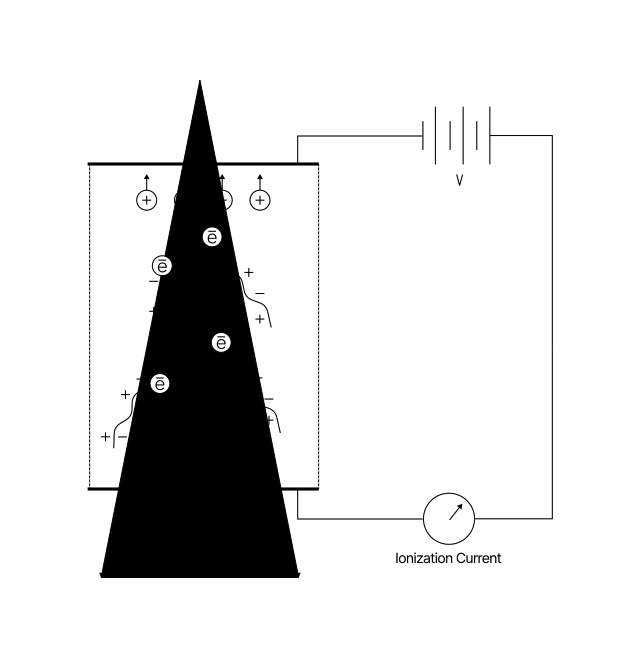
Operating Principle and Requirements
Технические данные
Number of Fields
3
Ionization Chamber Dimensions
470 × 480 × 6,5 mm
Anode Voltage Range
40–150 kV
X-ray Attenuation of the Ionization Chamber, max
Equivalent to 1 mm Al in the 70–90 kV range
Operating Dose Rate Range at the Input Plane of the Ionization Chamber
From 10 µGy/s to 40,000 µGy/s
Sensitivity Variation Between Ionization Chambers, max
±25%
Sensitivity Variation Between Fields of a Single Ionization Chamber, max
±10%
Sensitivity Deviation Depending on Anode Voltage, max
±20%
Reproducibility of Results
0.02 (coefficient of variation)
Response Time
No more than 1.6 ms
Weight, max
0.7
Operating Conditions
Temperature: +10 to +40 °C
Relative humidity: 35% to 85%, non-condensing
Atmospheric pressure: 860 to 1060 hPa
Relative humidity: 35% to 85%, non-condensing
Atmospheric pressure: 860 to 1060 hPa
Storage and Transportation Conditions
Temperature: −20 to +60 °C
Relative humidity: 35% to 85%, non-condensing
Atmospheric pressure: 860 to 1060 hPa
Relative humidity: 35% to 85%, non-condensing
Atmospheric pressure: 860 to 1060 hPa
Permissible Acceleration During Transportation
20 G
Output Connector
HU-7 connector
Output Signal
Analog, directly proportional to dose rate
Output Signal Range at ±15 V Supply
0 V to −13 V
Field Switching
Separate output wire for each field

Andrey Valeryevich Kunets
INN: 504601440286
INN: 504601440286
©2025
All rights reserved
All rights reserved
and.val.kunets@gmail.com
+7 915 212 34 07
+7 915 212 34 07